
Victorian Certificate of Education (VCE)
The VCE
The Victorian Certificate of Education (VCE) is a senior secondary qualification that recognises students’ achievement across a range of studies. It offers multiple pathways, including the VCE, VCE Vocational Major (VM), and Vocational Education and Training (VET), enabling students to pursue academic, applied, or vocational learning aligned to their goals.
What is the VCE?
The Victorian Certificate of Education (VCE) is usually undertaken during Years 11 and 12 to complete secondary education in Victoria. It is administered by the Victorian Curriculum and Assessment Authority (VCAA). To gain the VCE, you must satisfactorily complete at least 16 Units, including three Units of any English (English, EAL, English Language or Literature or VM Literacy) with at least two units being at Unit 3 and 4 level, and including three sequences of Unit 3 and 4 subjects (additional English studies may be included here).
VCE subjects require consistent, systematic, and focused effort over all four units of the specific subject to maximise the score at the completion of that subject.
For more information about subjects and pathways, please refer to the Senior School Course Information Book
VCE Q&A
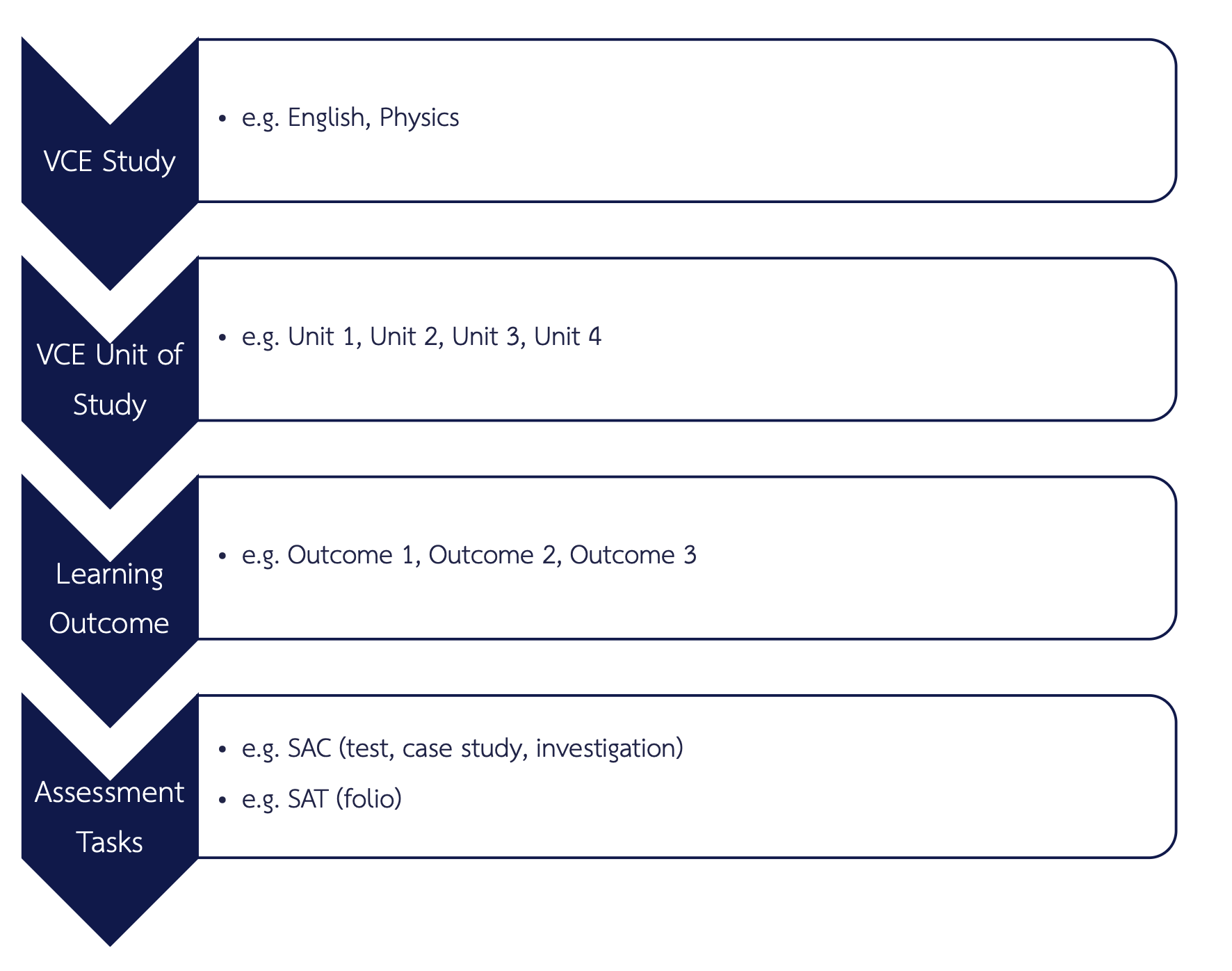
What is a VCE Study?
Each VCE study is designed to provide a two-year program. VCE studies comprise four units; numbered 1, 2, 3 and 4.
Units 1 and 2 may be completed as single units and are usually studied at Year 11, but Units 3 and 4 must be taken as a sequence and are usually studied at Year 12.
What is a unit?
A Unit is a semester's work in a subject, i.e., approximately half a year. Thus Units 1 and 2 are usually done in Year 11, and Units 3 and 4 in Year 12. A sequence is two Units done one after the other in a single subject. For example, Units 1 and 2 in Geography make a sequence.
Units 3 and 4 must be taken as a sequence. Units 1 and 2 can be taken separately, and Unit 2 may be taken without a study of Unit 1. Units 3 and 4 can be taken without first completing Units 1 and/or 2 in some subjects. For other subjects this may not be appropriate e.g., languages.
What is the VCE VM?
The VCE Vocational Major (VCE VM) is a program within the VCE. This certificate recognises vocational and applied learning pathways as equivalent to a traditional VCE but provides a more hands-on option for students in Years 11 and 12. Units taught are designed to develop student skills for those wishing to pursue a vocational pathway. To read more about these pathways, please see the Senior School Course Information booklet.
What is a Learning Outcome?
For every subject there is a series of learning outcomes. For example, in English at Unit 1 there are three outcomes.
The outcomes relate to the demonstrated ability of a student to:
- identify and discuss key aspects of a set text and to construct a response,
- create and present texts taking into account the audience purpose and text and
- identify and discuss how language can be used to persuade
These outcomes state what will be studied during the Unit and what students should be able to do by the end of the semester.
These are the areas that will form the basis of assessments and students must satisfactorily complete all of them.
What is an Assessment Task?
Within each Learning Outcome, there are several assessment tasks a teacher may use to determine if a student has achieved satisfactory completion. These can include folio(s) of exercises, case studies, class tests, assignments, and research projects.
An assessment task may assess more than one Learning Outcome. All tasks must be satisfactorily completed to be awarded this Outcome.
How do they all fit together?
The graphic below details how all these elements of the VCE work together in practice.
The VCE at Overnewton
This section outlines the delivery of the VCE program at Overnewton, highlighting key program structures, assessment expectations, and alternative learning pathways.
Entry into VCE Studies and VCAA Student Numbers
Each year all VCE students must sign a general declaration that they will obey the rules for the VCE and accept disciplinary provisions as set out by VCAA and the College.
Each term students must carefully check and sign their official VASS Student Details and Assessment Summary sheet. Students are responsible for accurately checking their VCAA enrolment details and for advising the College of errors in subject enrolments, enrolment in studies offered by external providers, change of address, etc.
VCE students have their own identification number provided by VCAA.
The VCE Program by Year Level
Year 10
All Year 10 students undertake Introduction to VCE Religion and Society over the full year. Some students may wish to apply to undertake an accelerated VCE Units 1 and 2 study.
Applications are reviewed by a panel, taking into account academic results, attendance and learning behaviours.
Year 11
In Year 11, students study SIX subjects (12 units over 2 semesters).
There must be at least ONE of either English, English Language or English Literature
ONE may be a Unit 3 & 4 sequence.
ONE may be a VET (Vocational Education & Training) sequence (e.g., Fitness).
There is a range of subjects offered for students to select from. Students must satisfy the prerequisites set by the College to be permitted to study a Unit 3 and 4 sequence at Year 11.
Year 12
Students typically study FIVE Unit 3 & 4 sequence subjects (10 units over 2 semesters).
There must be at least ONE of either English, English Language or English Literature or VM Literacy (if undertaking the VCE Vocational Major).
A student may also wish to study:
A Higher Education Study OR
A VET unit
In selecting a course of study for VCE it is important to understand that where there is more than one subject in the following Study Areas: English, Mathematics, History, Information Technology, Languages, and Music
Only two may be included in a student's best four subjects for calculation of the ATAR.
Three at most can be included in the calculation of an ATAR.
This applies regardless of whether a subject is a VET subject, a VCE subject, or a Higher Education Study.
To be eligible to receive their VCE, students must satisfactorily complete:
16 units including 3 units of an English study
Four Unit 3 and 4 sequences
Vocational Learning Pathways
The VCE Vocational Major (VM) and Vocational Education and Training (VET) programs provide practical, applied learning and vocational skills. Unlike the traditional VCE, they focus on real-world experiences, workplace learning, and industry-specific training, supporting students’ transition to further education, training, or employment.
VCE Vocational Major (VM)
To be eligible to receive the VCE VM, students must satisfactorily complete a minimum of 16 units, including:
3 VCE VM Literacy or VCE English units (including a Unit 3–4 sequence)
2 VCE VM Numeracy or VCE Mathematics units
2 VCE VM Work Related Skills units
2 VCE VM Personal Development Skills units
2 VET credits at Certificate II level or above (180 nominal hours)
Students must complete a minimum of three other Unit 3–4 sequences as part of their program. Units 3 and 4 of VM studies may be undertaken together over the duration of the academic year to enable these to be integrated.
The VCE VM can be tailored to the needs and interests of the student, to keep them engaged while developing their skills and knowledge. Students can also include other VCE studies and VET and can receive structured workplace learning recognition. Most students will undertake 16–20 units over the two years.
VET (Vocational Education & Training Programs)
VET subjects provide students with the opportunity to combine their VCE or VM studies with vocational training.
VET subjects also cultivate industry-specific skills, expose students to TAFE-style learning and allow them to attain a nationally recognised qualification.
Most VET subjects are two-year programs and successful completion result in credit for VCE Units 1 to 4.
It is important to note that some programs are scored (that is, the students attain a study score which contributes to their ATAR) whilst others are not.
A VET subject will contribute to the 180-hour requirement for VM students.
Successful completion of a VET subject requires students to:
demonstrate a competency in their understanding of the specific skills and tasks being studied.
adhere to minimum attendance hours – students must attend all VET classes punctually. Illnesses must be accompanied by a medical certificate and absences for school activities such as school camps or excursions must be communicated to the VCE Coordinator and the trainer/employer as soon as possible.
attend make up classes during school holidays if requested.
complete all assigned tasks punctually.
complete structured workplace learning as per the requirements of their training provider/employer.
As a student of Overnewton College, there is also an expectation that any student undertaking a VET program catches up any missed work from their VCE/VM program when away from school.
Please Note: any students enrolled in a VET program after the defined Census date by that learning provider will be billed for this program even in the event they choose to withdraw or not attend.
Special Consideration and VCE Provisions
VCAA recognise that students may experience acute or chronic conditions which negatively impact their VCE performance. These conditions may include illness, difficult circumstances, significant tragedy, an existing impairment, disability or learning disorder.
Individual students may need special provisions in their learning program to achieve the learning outcomes, and in assessment to demonstrate their learning and achievement. VCE Provisions are provided by VCAA to enable a student to demonstrate their capabilities in a subject if student’s learning and assessment programs are affected by illness, impairment, or personal circumstances. VCE Provisions provide equivalent, alternative assessment arrangements for students in specific circumstances.
Provision applications require supporting evidence, and students should discuss their eligibility for provision with the VCE Coordinator.
Note that simply being absent for an extended period does not qualify a student for any Special Provision. All absences must be supported by evidence.
Students who have been granted Special Provision are not exempt from meeting the requirements for satisfactory completion of the VCE, or from being assessed against the outcomes for a study. They are still required to demonstrate their achievement fairly in meeting the outcomes of the study design as well as completing School-based Assessments and VCE external assessments.
Some students will be afforded the provision of Small Group Room. Small group rooms will have a maximum of 16 students. In the event a class have 16 students or less, the class will be deemed a Small Group Room and students will complete their assessment with the remainder of their class.
Second Language Applications (EAL)
Students are eligible for second language status if they meet the criteria for their chosen language. An application form must be completed and be supported by evidence to show:
date of arrival into Australia (e.g., passport)
country of birth (e.g., passport or birth certificate)
period of education (e.g., school reports or a letter from the school indicating period of enrolment).
Application forms are available from the VCE Coordinator. To be enrolled in the study of a second language at Units 3 and 4 level, applications must first be submitted through the Student Services Office and are then sent to the VCAA to be approved externally.
Second Languages offered at our school are German and Chinese.